Introduction
Over 80% of online course creators report that student engagement — not content quality — is the primary reason learners abandon their programs. Building an active, invested community around your content isn't a nice-to-have anymore; it's the difference between recurring revenue and constant churn. That's exactly the problem both platforms in this Skool vs Kajabi comparison are designed to solve — but they approach it from completely different angles.
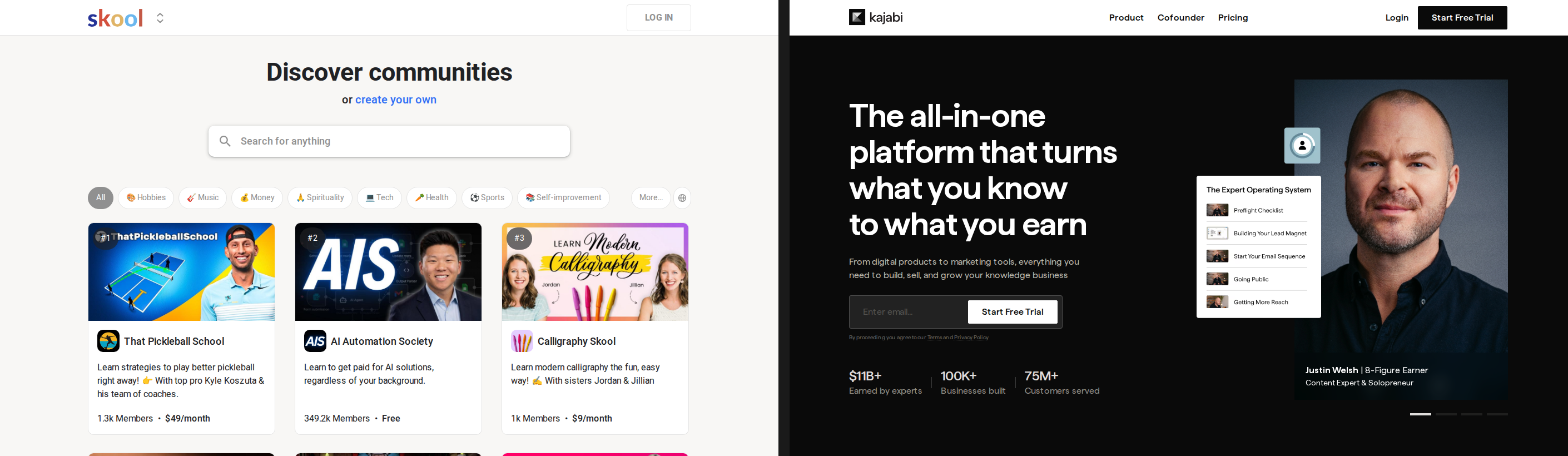
Skool is a streamlined community and course platform that puts member engagement at the absolute center of everything. Kajabi is a full-service online business platform that offers community features alongside email marketing, sales funnels, and website building. If you're researching Skool vs Kajabi, you're likely an online educator, coach, or content creator trying to figure out which platform will actually serve your business — not just look good in a demo.
In this review, we'll break down features, pricing, strengths, weaknesses, and the specific scenarios where each platform wins. By the end, you'll know exactly which one deserves your investment.
---
What is Skool vs Kajabi?
Understanding this comparison starts with recognizing that these are two very different tools pursuing a similar audience.
Skool was founded by Sam Ovens in 2019 with a deliberate philosophy: learning works best inside engaged communities. Rather than building an elaborate all-in-one platform, Skool combines course hosting, group discussions, and gamification into a single, intentionally simple interface. The result is a community tools platform where members actually show up, participate, and stay — driven by leaderboards, points, and unlockable content rewards. Visit Skool vs Kajabi's official website to explore Skool's community-first approach in detail. Kajabi, by contrast, has been a market staple since 2010. It's built for entrepreneurs who want to run their entire digital business from one dashboard — courses, email campaigns, sales funnels, landing pages, podcasting, and website management all live under one roof. Where Skool strips things down, Kajabi stacks them up.Both serve online educators and creators, but their philosophies diverge sharply: Skool prioritizes community depth and simplicity while Kajabi prioritizes business breadth and automation. Choosing between them isn't just a feature comparison — it's a decision about how you want to run your business and what kind of experience you want your members to have.
---
Key Features of Skool vs Kajabi
1. Community & Discussion Tools
This is where Skool genuinely shines. Its feed-style community interface, direct messaging, event calendar, and gamification system — including points, leaderboards, and unlockable content — drive authentic member engagement. Community isn't just a tab inside Skool; it's the entire product identity.
Kajabi added community features through Kajabi Communities more recently, and while they're functional, they lack the depth and engagement mechanics that Skool has built from the ground up. There's no native gamification, and the community experience feels secondary to the platform's marketing and course infrastructure. For creators whose business model depends on high member retention and daily activity, this distinction matters enormously.
2. Course Hosting & Delivery
Both platforms support video courses with drip content scheduling and quizzes. Kajabi edges ahead here with more advanced assessment tools, completion certificates, and deeper customization options for course layouts and branding.
Skool keeps course delivery intentionally clean and tightly integrated within the community space — members consume content without ever leaving the ecosystem. For creators who want simplicity over customization, Skool's approach reduces friction. For those building credential-based programs or complex multi-module curricula, Kajabi's course tools offer more flexibility.
3. Marketing & Sales Funnels
Kajabi dominates this category entirely. Built-in email campaigns, automation workflows, opt-in landing pages, checkout pages, upsells, and affiliate management make Kajabi a near-complete marketing stack. For creators who would otherwise pay separately for tools like ConvertKit and ClickFunnels, Kajabi can consolidate significant monthly expenses.
Skool offers virtually no native marketing tools. If you're running paid ads, building email sequences, or managing a sales funnel, you'll need external platforms connected via Zapier. This isn't a hidden limitation — it's a deliberate design choice. Skool focuses on what happens after someone joins, not the journey to get them there.
4. Website & Branding Capabilities
Kajabi includes a full website builder with customizable themes, giving creators a professional home base for their brand. Your courses, sales pages, blog, and community can all live on your own branded domain.
Skool offers minimal branding customization. Your community lives on a Skool-branded subdomain, with limited ability to match your wider brand identity. For established creators with strong brand equity, this is a meaningful constraint worth factoring into your decision.
5. Mobile Experience
Skool has a dedicated, well-reviewed mobile app that members actively use daily — a critical feature for community tools platforms where habitual engagement drives retention. The app experience mirrors the desktop community feed effectively.
Kajabi also offers a mobile app, though creator reviews note that it sometimes lags behind platform updates. Both platforms are mobile-accessible, but Skool's app currently holds the edge for member-side engagement.
6. Analytics & Reporting
Kajabi offers detailed funnel analytics, email performance metrics, and revenue reporting — giving business owners a clear picture of what's working across their entire operation. For data-driven creators, this level of visibility is invaluable.
Skool provides basic member activity and engagement metrics. You can track participation and community health, but you won't get the kind of revenue attribution or funnel performance data that Kajabi delivers. If analytics depth drives your business decisions, this is a real limitation.
7. Integrations
Kajabi integrates natively with Zapier, major email tools, and payment processors. Skool's integrations are more limited, relying primarily on Zapier for third-party connections. If you're building a complex tool stack, Kajabi's integration ecosystem gives you more flexibility out of the box.
---
Skool vs Kajabi Pricing & Plans
Pricing is one of the clearest differentiators between these two community tools platforms. View Skool vs Kajabi pricing options directly to confirm current rates, but here's the breakdown based on available information:
Skool operates on a single flat-fee model at $99/month, which covers unlimited members and one community. There are no transaction fees, and most use cases are covered under this single tier. A 14-day free trial is available. Kajabi offers multiple tiers starting at $149/month (Kickstarter), rising to $199/month (Basic), $399/month (Growth), and $599/month (Pro). Enterprise pricing requires direct contact. Kajabi also offers a 14-day free trial.The value calculation here depends on your tool stack. Skool wins on simplicity and cost at scale. However, Kajabi's bundled marketing tools — email marketing, funnels, website builder — could actually reduce total monthly spend for creators currently paying for multiple separate platforms. If you're already running ConvertKit, ClickFunnels, and a standalone hosting platform, Kajabi's higher sticker price may represent genuine consolidation savings.
---
Pros & Cons
Skool Pros:
✅ Genuinely sticky community features with gamification that drives daily engagement
✅ Flat, predictable pricing with no transaction fees and unlimited members
✅ Faster onboarding and simpler interface for both creators and members
✅ Excellent mobile app with strong member adoption rates
✅ Courses are seamlessly integrated inside the community experience
Skool Cons:
❌ No built-in email marketing or automation tools
❌ Minimal customization and branding options
❌ Not suited for complex sales funnels or multi-step automations
❌ Limited analytics beyond basic engagement metrics
Kajabi Pros:
✅ True all-in-one platform covering courses, email, funnels, and website
✅ Powerful marketing automation capabilities
✅ Professional website builder with customizable themes
✅ Strong analytics and revenue reporting
✅ Mature product with broad native integrations
Kajabi Cons:
❌ Significantly higher price point, especially at growth tiers
❌ Community features are less sophisticated and lack gamification
❌ Can feel complex and overwhelming for creators who only need core community tools
❌ Mobile app lags behind platform updates according to creator reviews
---
Skool vs Kajabi vs. Alternatives
When evaluating community tools platforms more broadly, a few other names deserve consideration alongside Skool and Kajabi.
Circle is a direct competitor to Skool in the community-first space. Like Skool, it emphasizes member engagement and discussion, though it lacks Skool's native gamification system. Circle integrates with a wider range of external tools, which may appeal to creators already locked into specific platforms. Teachable and Thinkific compete more directly with Kajabi on the course-hosting side, offering professional course delivery with more pricing flexibility at the entry level. However, neither matches Kajabi's marketing automation depth, and both lack meaningful community tools. Mighty Networks occupies a middle ground — stronger community features than Kajabi but more business infrastructure than Skool, including branded apps and courses. It's worth evaluating if you want community depth with slightly more marketing flexibility than Skool provides.Ultimately, if community engagement is your north star, Skool leads the field. If you need a full business platform with marketing automation, Kajabi's all-in-one approach remains the most comprehensive option in the market. Explore Skool vs Kajabi to assess where your priorities fall.
---
Who Should Use Skool vs Kajabi?
Skool is ideal for:- Coaches and educators whose business model depends on high community engagement and member retention
- Creators launching their first paid community who want a simple, fast setup without a steep learning curve
- Established creators who already have external marketing tools (email platforms, funnel builders) and don't need to replace them
- Anyone who values predictable flat-rate pricing at scale without per-member fees
- Entrepreneurs who want to consolidate their entire online business — courses, email, funnels, website — into a single platform
- Established creators with significant revenue who can justify the higher price point for reduced tool sprawl
- Course-focused creators who need advanced assessments, certificates, and professional branding
- Business owners who rely heavily on email marketing and automated sequences to drive course sales
Contact Skool vs Kajabi to discuss your specific use case and confirm which platform aligns with your business model.
---
Getting Started with Skool vs Kajabi
Both platforms offer a 14-day free trial, which is the best way to evaluate fit before committing. Visit Skool vs Kajabi to start your Skool trial — setup is straightforward, and most creators can have a functional community live within a few hours. The onboarding focuses on creating your community space, setting up your first course or post, and inviting founding members.
For Kajabi, the onboarding process is longer by necessity — there's simply more to configure across website, email, funnels, and courses. Kajabi offers guided setup workflows that help new users prioritize tasks, but expect a steeper initial time investment.
Regardless of which platform you choose, the critical first step is getting clear on your primary goal: Is it building an engaged daily-active community, or running a complete automated online business? That single question will guide you to the right platform faster than any feature checklist.
---
Final Verdict
After a thorough breakdown, the Skool vs Kajabi decision comes down to one core question: do you need a community tools platform or a business operations platform?
Skool vs Kajabi demonstrates that Skool is the clear winner for creators who put community engagement first. Its gamification system, clean interface, mobile app, and flat pricing make it genuinely excellent at what it's designed to do. If member retention and daily activity are your success metrics, Skool delivers.Kajabi wins for creators who need marketing infrastructure baked in. If you're running email campaigns, building automated funnels, and managing a professional brand presence, Kajabi's all-in-one platform justifies its premium pricing — especially when it replaces several separate tools you're already paying for.
Neither platform is objectively better. They're optimized for different stages and styles of online business. Newer creators and community-focused coaches will likely find Skool's simplicity and pricing more accessible. Established online entrepreneurs managing complex marketing operations will find Kajabi's depth indispensable. Check out Skool vs Kajabi and take advantage of both free trials before making your final call.
---
Frequently Asked Questions
Q: How much does Skool vs Kajabi cost?A: Skool charges a flat $99/month covering unlimited members with no transaction fees. Kajabi starts at $149/month and scales up to $599/month for the Pro tier, with enterprise pricing available on request. Both offer 14-day free trials. View Skool vs Kajabi pricing for the latest rates.
Q: What makes Skool different from Kajabi?A: Skool is purpose-built for community engagement, featuring gamification (points, leaderboards, unlockable content), a highly rated mobile app, and a simple interface. Kajabi is a full business platform with marketing automation, email campaigns, and website building built in. Skool focuses on what happens after someone joins your community; Kajabi manages the entire journey from lead to customer.
Q: Does Skool have email marketing tools?A: No. Skool has virtually no native email marketing or automation capabilities. Creators who need email campaigns and sales funnels must use external tools connected via Zapier. Kajabi, by contrast, includes full email marketing and automation as core features.
Q: Is Kajabi worth the higher price?A: It depends on your current tool stack. For creators already paying for separate email marketing platforms, funnel builders, and website hosts, Kajabi can consolidate those costs and potentially reduce total monthly spend despite its higher sticker price. For creators who only need a community platform, the premium is harder to justify.
Q: Which platform has better community features?A: Skool leads on community tools. Its gamification system, member leaderboards, and engagement-focused design drive higher daily activity than Kajabi's community features, which were added more recently and lack native gamification mechanics. For pure community depth, Skool is the stronger choice.